
Babalakin & Co
The Energy Law Series I
(Bridging the gap between the Law and the People)
The US/Israel-Iran War and its impact on the fluctuating prices of Petroleum Products in Nigeria; A view from the Lens of the Nigerian Law
Introduction
Crude oil has been central to global industrialization and economic growth since its discovery, but its pricing has always been vulnerable to geopolitical uncertainties such as wars and pandemics.[1] Conflict across the Middle East is intensifying after the United States and Israel carried out extensive strikes on Iran on 28 February 2026.[2]
The US/Israel–Iran war has triggered a sharp increase in global oil prices, driven primarily by fears of massive supply disruptions in the Middle East, especially after the partial closure of the Strait of Hormuz by Iran.[3] Nigeria has also had a fair share of the increase in petrol and petroleum products, due to the crisis in the Middle East. The Dangote Refinery
has adjusted its petroleum prices repeatedly in a bid to cope with the price volatility caused by the war. The current trajectory of petroleum product pricing in Nigeria poses profound economic risks. Unsurprisingly, this has triggered widespread public concern, as many Nigerians struggle to grasp why a conflict in the distant Middle East has such a direct and immediate impact on domestic fuel prices in Nigeria, an oil producing country.[4]
In this maiden edition of the Energy Law Series, we examine the nexus between the ongoing US/Israel–Iran war, the consistent hike of prices of petroleum products in Nigeria and the position of the Nigerian law on these issues.
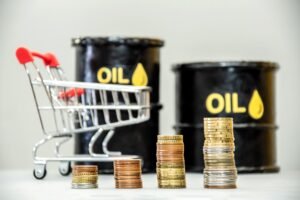
The US/Israel-Iran War; the Cataclysmic event which may rewrite global history
It is widely believed that the war in Iran represents the “final battle” that stands to change not just oil prices but the world. According to Ray Dalio, the founder of hedge fund Bridgewater Associates, one of the largest hedge funds globally, “it all comes down to who controls the strait of Hormuz”[5] The highly respected investor and entrepreneur stated that “the pattern of events that leads to the breakdown of empires is almost always the same. The ‘final battle’ that determines winners and losers also reshapes history and redirects financial flows, affects the debt, currency, and gold markets, and shifts geopolitical power. People, countries and financial flows flock to the winner.”[6]
The price of crude has risen above $100 per barrel and is currently hovering above $115 per barrel. As at 19th March 2026, Brent crude rose above $119 per barrel, up from roughly $70 before the war with Iran began.[7] Iran has been accused of attacking ships in the Gulf, leading to the effective closure of the Strait of Hormuz.[8] On 21st March 2026, Trump issued a 48-hour ultimatum to Israel to fully reopen the Strait without threat, warning that the US would “obliterate” Iranian power plants if it failed to comply. In response, Iran said it would target US-linked energy and desalination infrastructure in the region if such action were taken. Attacks have also been reported on major oil and gas hubs, prompting some of the world’s largest producers to suspend production and causing further surge in global energy prices.[9]
Due to limited refining capacity, Nigeria relies heavily on imported fuel and other petroleum products. As a result, retail prices in the domestic market are directly influenced by volatility in global crude oil prices. This vulnerability has been further compounded by the deregulation of the downstream sector, following the removal of government controls and subsidies on the pricing, supply, and distribution of petroleum products such as petrol, diesel, and kerosene. With no subsidy cushion in place since 2023, consumers are now fully exposed to international price fluctuations, leaving households and businesses more vulnerable to external shocks such as those triggered by the ongoing US/Israel-Iran war. Since the start of the war, petroleum product prices in Nigeria have risen sharply. Fuel prices, for instance, have increased from average N865 to between ₦1,200 and ₦1,300 per litre in many parts of the country. The Dangote Refinery has significantly raised its gantry fuel price, moving from about ₦774–₦799 per litre to as high as ₦1,175 per litre. Industry experts warn that if the conflict continues, prices could climb even higher, going beyond ₦1,500 per litre and possibly reaching ₦2,000 per litre.[10]
The Dangote Refinery is Nigeria’s flagship oil refining project, located in the Lekki Free Zone, Lagos. It is the largest single‑train refinery in the world, with a designed capacity of 650,000 barrels per day, and plays a central role in Nigeria’s efforts to reduce dependence on imported fuel. The impact of the Dangote Refinery has been felt within and outside the shores of Nigeria. It has also been recognized by some African countries as the beacon of hope in the dire and torrid times caused by the war in the Middle East. According to Bloomberg, African nations that have long been reliant on giant refineries in the Persian Gulf for fuel are in a quagmire as the Iran war has placed a chokehold on supplies. Due to this, African nations, which include Ghana, South Africa and Kenya have now indicated their interest in becoming customers of the Dangote Refinery.[11] As at 23rd March 2026, Bloomberg reported that Dangote has now exported 456,000 tonnes of fuel to 5 (five) African countries.
In view of the capacity of the Dangote Refinery, the impact of the US/Israel-Iran War in Nigeria could have been minimal, if a large volume of the crude that Dangote refines is provided for locally. Unfortunately, the Dangote Refinery, albeit in a country which produces crude, still imports a considerable percentage of its crude to sustain operations. Sometime in 2024, the management of the Dangote Refinery expressed concern over its inability to secure crude oil from upstream companies for its operations, urging the Nigerian Upstream Petroleum Regulatory Commission (the “Commission”) to intervene and ensure full compliance with the provisions of the Petroleum Industry Act 2021 (PIA) by local producers. The Dangote Refinery also noted that attempts to source crude domestically have led to additional costs, with premiums of $3 to $4 per barrel above international benchmark prices; making local supplies more expensive than imports from producers outside Nigeria. Also in 2025, it was reported that the Dangote Refinery imported about $3.74 billion worth of foreign crude, underscoring the scale of its demand and the structural challenges in Nigeria’s oil trade.[12] This is despite the Federal Executive Council’s directive on 29th July 2024 to the Nigerian National Petroleum Company Limited to commence sale of crude oil to domestic or local refineries in Nigerian Naira in place of the largely prevalent practice of sale in United States Dollars.
It is noteworthy that the Dangote Refinery is currently receiving just 5 (five) crude oil cargoes per month from the Nigerian National Petroleum Company Limited, which is less than half of the thirteen (13) cargoes required to maintain full supply of petroleum products.[13] This shortfall is forcing Africa’s largest oil refinery to seek more costly imports from international markets. Consequently, the Dangote Refinery sets its pricing based on international crude oil benchmarks, meaning that any increase in global crude costs is quickly reflected in its gantry price and, ultimately, in pump prices across Nigeria. This is the reason why the Dangote Refinery has hiked the price of petroleum products to remain commercially viable amidst the sharp increase in global crude prices sparked by the Iran war.
The position of the Nigerian law viz-a-viz the impact of the US/Israel-Iran War on global crude prices
The PIA provides that “the Commission may issue regulations or guidelines on the mechanism for the imposition of a domestic crude oil supply obligation on lessees of upstream petroleum operations, including applicable penalties.”[14] Accordingly, the Commission issued the Production Curtailment and Domestic Crude Oil Supply Obligations 2023 (the “Regulations”)[15] which applies to production curtailment and utilization of petroleum in relation to export and domestic crude oil supply obligation. The Commission also issued the Guidelines for the Operationalisation of Domestic Crude Oil Supply Obligation, 2024.
The Regulations provide for the sale of crude oil to Nigerian refineries which are in operation, having regard to the prevailing international market price for similar grades of crude oil and on a willing supplier and willing buyer basis. The Regulations also provides that crude oil produced by a lessee shall be subject to domestic crude oil supply obligations imposed by the Commission. By the Regulations, the Commission shall allocate production quota to lessees from time to time and also curtail the export of crude oil where domestic crude oil supply obligations remain unsatisfied. Where production for any given quarter falls below the allocated quota for that quarter, a lessee (an upstream company) shall fulfil its obligation to supply to the domestic market before any export may be permitted by the Commission.[16] A lessee or an upstream company may only export all the production for that quarter where there is no demand by any refinery licence holder in that quarter.[17]

Compliance and enforcement of the Regulations would have guaranteed a consistent supply of crude oil to Nigerian refineries in operation, particularly the Dangote Refinery. However, it has been reported by the Dangote Refinery that “non-compliance by upstream operators has left it with no choice but to source a substantial portion of its crude feedstock through international traders, who charge additional premiums on top of already elevated spot market prices.”[18] Additionally, the Commission is lax in its compliance with some of its obligations as provided by the Regulations. For instance, the Commission is mandated by the Regulations to publish biannually (1st January and 1st July) on its official website and in three national newspapers the domestic crude refining requirements of operating refineries in Nigeria based on information provided to the Commission by the Nigerian Midstream and Downstream Petroleum Regulatory Authority (the “Authority”).[19] The purpose of the information which the Commission is mandated to publish is to facilitate crude oil sales transaction between producers and operating refineries in Nigeria. A perusal of the Commission’s website as at 23rd March 2026 shows that the Commission is yet to publish the domestic crude refining requirements of operating refineries in Nigeria in 2026. It is difficult to state with certainty that the failure of the Commission to publish the refining requirements is due to the lack of information from the Authority. However, it is clear that either the Commission or the Authority is standing in the way of crude oil sales transaction between producers and operating refineries in Nigeria.
As devasting as the US/Israel-Iran War is, it will continue to expose the issues in the regulatory system of different countries. As long as a large volume of the crude oil refined by the Dangote Refinery is sourced internationally, the Dangote Refinery will continue to adjust the petroleum prices to cope with the ripple effects of the US/Israel-Iran War on its operations. The blame cannot therefore be placed at the doors of the Dangote Refinery, neither can it be placed entirely on the US/Israel-Iran War.
Did you Know?
This is a publication of Babalakin & Co and it is intended for general information only. It should not be construed as a legal advice under any circumstance. Babalakin & Co shall bear no liability for any reliance on this publication. For further information on the foregoing, please contact:
REFERENCES
[1] AK Patidar, ‘Impact of global events on crude oil economy: a comprehensive review of the geopolitics of energy and economic polarization’, Geojournal (2024) 89
[2] Why did US and Israel attack Iran and how long could the war last? Available at https://www.bbc.com/news/articles/cx2dyz6p3weo accessed on 23rd March 2026
[3] The Strait of Hormuz is the world’s critical maritime energy chokepoint, with roughly 20% of global oil consumption and one – third world’s liquefied natural gas passing through it
[4] https://www.thecable.ng/iran-war-and-the-economics-of-fuel-costs/ <accessed on 19th March 2026>
[5] https://www.businesstoday.in/world/story/it-all-comes-down-to-who-controls-strait-of-hormuz-ray-dalio-says-no-agreement-will-resolve-iran-war-520909-2026-03-17 accessed 23rd March 2026
[6] ibid
[7] Stan Choe; Brent Crude Briefly Tops $119 Per Barrel, Before Receding, And Shakes Stock Markets Worldwide Available at https://www.huffpost.com/entry/financial-markets-iran-war_n_69bbb6d3e4b05b29d3cab5a8 accessed 23rd March 2026
[8] Why did US and Israel attack Iran and how long could the war last? Available at https://www.bbc.com/news/articles/cx2dyz6p3weo accessed on 23rd March 2026
[9] ibid
[10] https://punchng.com/us-iran-war-petrol-price-surge-sparks-relief-calls/ <accessed on 19th March 2026>
[11] Paul Burkhardt; Africa Turns to Dangote’s Monster Refinery in Hunt for Fuel Available at https://www.bloomberg.com/news/newsletters/2026-03-20/next-africa-fuel-starved-nations-flock-to-dangote-s-refinery accessed on 23rd March 2026
[12] The Punch Newspaper, available at https://punchng.com/dangote-imported-3-74bn-crude-in-2025-cbn/ <accessed on 19th March 2026>
[13] Oladehinde Oladipo; Dangote Refinery gets only 5 of 13 needed crude cargoes from NNPC Available at
https://businessday.ng/energy/article/dangote-refinery-gets-only-5-of-13-needed-crude-cargoes-from-nnpc/ accessed 23rd March 2026
[14] Section 109 (2) of the PIA
[15] We are aware that there is a draft amendment to the Regulations to ensure an effective administration of the Regulations.
[16] Paragraph 15 of the Regulations
[17] ibid
[18] Oladehinde Oladipo supra note 13
[19] Paragraph 10 of the Regulations